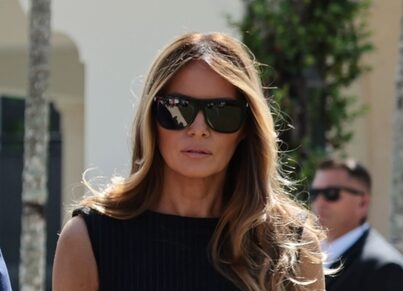
First Lady Melania Trump broke from her typically reserved public role to weigh in on a U.S. Supreme Court decision, praising the high court for upholding West Virginia’s and Idaho’s laws that bar transgender females from competing in girls’ and women’s sports.
The statement, posted via Melania’s account on X on June 30, marked a rare policy comment from the first lady since President Donald Trump returned to the White House on Jan. 20, 2025.
Melania Calls for Balance Between Inclusion and Fairness
“As many of you may know, I fully support the LGBTQIA+ community. But we must also ensure that our female athletes are protected and respected,” Melania said in her X post.
She went on to frame her position not as a rejection of LGBTQIA+ rights but as a call for holding two values simultaneously — that the nation can uphold LGBTQIA+ rights while also ensuring fairness in women’s sports and protecting female athletes.
Melania pointed out that this is not a new position for her. She referenced page 156 of her memoir, “MELANIA” — a No. 1 New York Times bestseller — noting she first voiced this stance in the book.
The Supreme Court Ruling
The U.S. Supreme Court ruled on June 30, 2026, upholding West Virginia’s and Idaho’s laws restricting transgender females from participating in girls’ and women’s athletic competitions. The ruling addressed Title IX, the federal law prohibiting sex-based discrimination in educational programs.
Outside the Supreme Court building, demonstrators gathered to mark the decision. Supporters of the ruling held signs and cheered as news of the outcome spread.
The court ruled 6-3, with Justice Brett Kavanaugh writing for the majority. But the split was not clean along ideological lines on every question. All nine justices, including the three liberals, Justice Sonia Sotomayor, Justice Elena Kagan, and Justice Ketanji Brown Jackson, agreed that the West Virginia and Idaho laws do not violate Title IX, the federal civil rights law barring sex discrimination in education. Where the court divided 6-3 was on the constitutional question: the conservative majority held that the bans also do not violate the Fourteenth Amendment’s Equal Protection Clause, while the three liberal justices dissented on that point. Writing for the dissent, Sotomayor argued that the majority had rushed to resolve “deeply sensitive, contentious, and evolving issues” without allowing the challengers a full opportunity to make their case.
A First Lady With Longstanding LGBT Ties
Melania Trump has long been associated with Log Cabin Republicans, an organization representing LGBT individuals within the conservative movement. That background informs her framing of the Supreme Court ruling — she positioned it as confirmation that fairness in women’s sports and support for LGBTQIA+ people are compatible goals.
Melania’s post quickly ignited a fierce debate online. Far-right critics dismissed her LGBTQ+ support as “virtue signaling” and expressed disappointment, with some MAGA loyalists arguing that the president and the first lady are not conservative enough on social issues. At the same time, LGBTQ+ advocates were equally critical from the other direction, accusing her of sending mixed messages and questioning the sincerity of her support for the community.
The first lady’s carefully worded statement stood in sharp contrast to her husband’s reaction. While Melania attempted to balance two values, President Donald Trump was far less nuanced, hailing the decision on Truth Social as a “BIG WIN” and declaring the ruling “takes that ridiculous situation off the table.” The divergence in tone between the two underscored Melania’s historically independent approach to social issues compared to the more combative style of the 47th president.
In the days following the ruling, the National Collegiate Athletic Association (NCAA) signaled it would not be changing its existing policy on transgender athletes. NCAA President Charlie Baker said the organization had already adopted the standard put forth by the Trump administration and would continue to apply it at the college level. “Our national standard is going to be what we expect our schools to use with respect to eligibility issues for college sports,” Baker said. He noted that state-level policies for high school and youth sports would vary separately.